.png)
I'm so excited for our guest today. She has done, a ton of high-volume hiring at a large, breadth of companies, including some of the biggest tech names that you know, Apple, Canva, uh, Lucid Motors, all where she hired over 1,200 people in 18 months to get an EV factory ready for production. Um, she's now taken everything she's learned in that space and applied it to one of the most, I would say, underestimated recruiting challenges out there, which is, um, the trades and looking for skilled labor. She's been hands-on with AI sourcing, screening, interview intelligence tools, and she has some real input on what works and what doesn't. She's currently the director of talent acquisition at A1 Garage Door Service. Sophie Roberge, welcome to the show.
Sophie Roberge: Good morning
Colleen Gallagher: well, let's dive right in. I love to start the show off with asking, what do you think is the one thing or, or one action that sets the best recruiters apart from the rest?
Sophie Roberge: Uh, the responsiveness, urgency, empathy. These are some of the things that I look for in my recruiters. a, it's, it's a tough market right now, and it's even more important now. The responsiveness especially, right? People are looking for jobs. They have bills to pay, and it feels like their applications are sent in a big void right now. They feel like nobody's answering them, and it takes forever. Um, and there's a lack of, um, transparency as well. So I'm a huge fan of recruiters that are transparent, recruiters that give feedback, coach their candidates. We have a really, really tight, um, of a timeline with our candidates at our company. We basically process every single candidates within two days of the application at A1, and that says a lot about our brand, about how much we care. Um, so we have about 100,000 applicants a year for a garage door
Colleen Gallagher: Wow.
Sophie Roberge: Probably very surprising to hear.
Colleen Gallagher: Yeah
Sophie Roberge: you know, we have over 40 locations nationwide. We operate under four brands. We're a private equity-backed and also privately owned. And so we have 700 technicians on the road right now, a total of 1,200 employees. So those 100,000 applicants get processed by four recruiters within two days. Uh, so imagine that timeline, how fast that is. So had to rely on, you know, one, you know, being really, like, all having the same North Star, right? All believing that this matters. It does not matter just 'cause we need to hire, but it matters for the candidate, and it matters for the brand as well, right? When you have a great brand, when people know the experience is great, our employees refer us at an alarming rate. They love referring us because they know if they put a referral through, that person is gonna hear in one or two days if they get invited to an interview or not. Uh, but we've had to rely heavily on systems as well to bring automation and to bring just some efficiencies. There's just no way we could process those the old f- even two years ago, the technology we had two years
Colleen Gallagher: Yeah
Sophie Roberge: we'd never be able to. You know, I would need 10 recruiters to be able to process this
Colleen Gallagher: Yeah.
Sophie Roberge: It in a good way
Colleen Gallagher: Yeah. Okay, so let's dig in there because 100,000 applicants with four recruiters, like h- how?
Sophie Roberge: Not easily or
Colleen Gallagher: Yeah
Sophie Roberge: We're all like, "Ugh," a little disheveled at the end of the day. Um, but I think like what's really, really w- so first of all, really smart systems, right? We use Ashby. It's, it's not a secret that I'm a huge fan of Ashby. It's an incredibly smart ATS. It's easy for candidates to apply, and it's easy for also us to see our pipeline. Awesome dashboards. My recruiters will see every morning when they get in, they have 64 new applicants from the day before, and they just cl- and so we utilize, um, everything is automated as well. I don't even have coordinators. I don't have anybody scheduling for them. So we've had to really kind of set up Ashby in a really smart way, right? So a ton of automation. As soon as we, you know, move somebody forward, they get an email and a text that they're invited to get on our calendar. So there's no back and forth about when are you available? We'd like to talk to you. We're like, it's very, very quick. Um, reasons are all uploaded. All our templates are uploaded as well. So there is quite a bit of automation there that happens. Um, so there's, there's nothing really left for my recruiters to kind of manually do, right? Other than just reviewing people. And we've also really leveraged all the AI function that Ashby has to offer. We, we tried a lot of other companies as well. Maybe we can get into this as well, but Ashby itself has some awesome features like AI criteria, for example. So we're able to really shortlist super quickly, uh, the people that we want to talk to. So roles, for example, that can have 1,000 applicants over a weekend, um, customer service rep, for example, right? So you call, your garage door's broken, you want to talk to somebody. We have a huge team of customer service reps, and those roles are remote. So when we post those roles, 1,000 applicants over a weekend, it would be impossible for my recruiter to kind of review all 1,000. It would take her days to just invite, you know, 20 to the interviews and end up hiring five potentially. Um, so this is where really not having a huge team really forced us to look at efficiencies and automation. And so using the AI criteria that we have in there, we're able, and it pulls right from the job description, right? And what are some of the things that you're looking for? Experience in a call center, for example, right? Uh, handling customer escalations or looking for people with a home services background, um, or a business that has some kind of urgency background. Can even be medical or dental or that kind of thing, because when your garage door's not opening or closing, you need to get out of your house, so you
Colleen Gallagher: Great
Sophie Roberge: in here. There's an urgency to it. Um, and so being able to use those criteria has really helped us kind of shortlist already, and then we're able to go, "Yep, invite, invite, invite, decline, decline, decline," right? So we can do this very quickly. Um, we can process candidates, you know, 100 candidates in an hour utilizing our systems, so we're able to really, uh, stay on top of it for that.
Colleen Gallagher: I think one of the biggest myths right now is that AI in recruiting is working against candidates.
Sophie Roberge: No.
Colleen Gallagher: So obviously
Sophie Roberge: my
Colleen Gallagher: using it a lot. Tell, tell us your, your take on that
Sophie Roberge: You know, there's one myth I would like to bust out there. Ghost job is one of them, and the second one is this one. job's all the rage right now on LinkedIn.
Colleen Gallagher: Yeah
Sophie Roberge: I wish candidates would not assume that if they're not selected for a job, it's the fault of AI, or AI rejected them, or humans are not looking at their resumes. You know, candidates that are qualified will be surfaced by AI, if anything, unless their resume has none of the qualifications we're looking for, right? And so AI's pretty smart too. Like for us, we're looking for people that are hospitable. So we love people that come from food service, that come from any business that has a customer service aspect to it, that has a sales aspect to it, kind of consultative sales. Or it could be gym membership or, uh, it could be, uh, realtors. It could be people that are selling furniture, selling cars. So anybody that has a relation- uh, roofing is great. Um, pest control is great. So there's a lot of businesses out there with is a consultative sales approach. So we're not direct, right? So it's not like, "Look for the word roofing. If you don't have roofing, you'll be eliminated."
Colleen Gallagher: Right
Sophie Roberge: more like, so AI is smart enough to understand context
Colleen Gallagher: Mm-hmm.
Sophie Roberge: And to kind of surface people. And if it's not sure, it'll say like, "May have the skill, but you know, we're not really sure here." Uh, you know, take another look at their resume. But if somebody is, has a certain skill and it matches the job, AI will find you, and that's I think what people need to know. it would be insane for us to work with AI that does the opposite, right? We have so much work to do. I don't want AI to eliminate qualified candidates or to ident- to not identify a qualified ca- uh, AI AI never eliminates. We always do every single resume. Every single of those 100,000 applicants had eyes on it by a recruiter, and a recruiter had to decide, "Correct, AI says this person has none of the qualification." That's true. It, it's very easy to, to, to verify those things, right? Um, so I think, you know, if you're somebody in accounts payable that has accounts payable experience, and it's on your resume as accounts payable, and you're applying for an accounts payable role, uh, even if there's 5,000 applicants, the people with the experience will be surfaced.
Colleen Gallagher: Yeah
Sophie Roberge: think that, um, I understand candidates now that are frustrated and, you know, it, it's sometimes we're humans, right? We're gonna look at external thing, things that have nothing to do with our qualifications, um, or our experience. But, um, it's not AI. AI is not the problem. AI
Colleen Gallagher: Yeah
Sophie Roberge: if you have got the qualifications.
Colleen Gallagher: How are you dealing with... And, and perhaps it's not happening as much in terms of, maybe the answer is that it's not happening as much, but the thing I hear a lot from TA leaders is the, the challenge is even when you have those workflows set up, now people are using the job description to write the resume, and so it's really hard once you look at the resume to know whether or not that person is actually representing themselves appropriately. And so how are you dealing with that aspect, or are you seeing that much?
Sophie Roberge: We're seeing it quite a bit. So we're not-- So we have, you know, kind of two pockets of recruiting at A1. So we have the professional roles or what we call the corporate roles, um, and those roles, so the most challenging probably, right? So folks from IT, they're savvy. Their resumes are incredibly polished and look like they're an absolutely great fit, and, uh, they're auto-applying for jobs. There's lots of tools now that will let candidates apply for jobs, and so they probably didn't fill out the application either. They, you know, the, uh, AI tool filled that out. Um, and so we are seeing a lot of perfect resumes on the corporate side, resumes that, that, you know, read exactly like the job description. And so, you know, we have to kind of, you know, read between the lines a little bit, look at the company, and we have to take chances. You know, we can't say, "This resume's too polished" or "It looks like it was made by AI, so we're not gonna give him a shot." I would use AI if I was writing a resume right now. I would want it to be consistent, 'cause, you know, you write your resume and then you get another job, and all of a sudden it's like it's not consistent, and you're like, "I want this to be better." And so I think it's smart to use AI to polish our resumes to make sure that, uh, it's compelling as well and that it's professionally written. Lots of resumes are still not very professionally written. I"ll take those too I don't mind somebody who's a little... I can tell they wrote this up and they were not too polished about it. I think that that authenticity actually really stands out now. So I think utilizing AI to make sure that your resume, um, has the right level of vocabulary maybe. And, and then like the prompts are really important, right? So if you're writing a resume for a VP role, it'd be very different than if you're retiring and you wanna go work at Trader Joe's, right? The tone will be different. When I write my resume to go work at Trader Joe's, it will sound different than if I'm looking for a job as a VP of recruiting. Um, and so I think the tone is important. Um, I'm a huge fan of u-utilizing AI, and I can't blame candidates for doing it, but that authenticity really matters. We need to go back and then remove all the stuff that makes it look like it's obviously written by AI. Weird verb tenses, not verb tenses, but vocabulary that doesn't sound like you. So, you know, the more people talk with their AI and the more they get to know their tool their tool gets to know them, the more authentic it sounds. If you've never used AI and you're like, "Write me a resume to match this job description," I mean, we, might still invite you for a resume, but ultimately you will be found out. You know, if you're not qualified for a job, you might get invited to interviews, but it's not gonna land you a job. Right. Exactly. Yep I don't understand it, either.
Colleen Gallagher: guess so.
Sophie Roberge: If you're able to put something out really quick or fantastic anal- you know, analysis or something that it's correct. Like, if it's correct and it's fast, like why wouldn't we wanna use something that is
Colleen Gallagher: Yeah.
Sophie Roberge: What it used to be? There's definitely tasks that used to take me days that I can whip up now
Colleen Gallagher: Yeah
Sophie Roberge: very, very quick time if my prompts are great and verify the information. I think it still takes qualification, right? You can't just outsource all your knowledge.
Colleen Gallagher: Exactly
Sophie Roberge: look at what AI is spitting out and, and then go, "Okay, yeah, that's
Colleen Gallagher: Yeah. sticking on the AI, piece for a second, I know you've, you are, someone who's very interested in all the different technologies around here, and it sounds like you've tried quite a few, and I think you said you've ch- you've used an AI screening tool in the past where it, it conducted the first round of interviews, but had actually a pretty low candidate participation rate. Like, what do you think went wrong there and, and how are you thinking about using that in the future?
Sophie Roberge: Yeah. The first one we used, I wasn't seeking one out, but somebody reached out to me on LinkedIn and, um, you know, was kind of impressed by the volume of, that we were processing and was like... And I, I didn't even know it existed. So that was just about two years ago, and that was
Colleen Gallagher: Yeah
Sophie Roberge: And those guys really specialize into trade, so that was very interesting. And,
Colleen Gallagher: No
Sophie Roberge: um, you know, they were owner, it was a startup. It was very fun to kind of be part of it with these guys.
Colleen Gallagher: Yeah
Sophie Roberge: it was a really cool tool. I found-- So we had about 20% of people that would take the AI screen, right? That would say, "I wanna do this." Um, so it was not a huge time saving for my recruiters, obviously, because there's, there are some candidates who are like, "Oh, this candidate looks great." They were invited. They haven't taken it yet. I'm gonna wait another day, but if they don't, I'm gonna invite them. So there was this whole kind of waiting game. Are they going to? Are they not going to? We still wanna talk to them. So we didn't make it a condition. Um, we made it something optional. You can opt for this, or you can decide not to do it. And if after three days they had not, you know, done it, then we would schedule a screen with them.
Colleen Gallagher: Mm-hmm.
Sophie Roberge: Of the screens that we conducted, their feedback was actually really positive. So that, um, that platform had a way for candidates to give it a smiley face or, you know, an, a neutral face or an angry face, uh, at the end. And it turns out that two years ago, people were surprised by how pleasant the experience was and how easy it was, right? So huge benefits for people, especially in the trades. They can do it after work. They can do it at 2:00 a.m. They can do it any time they want
Colleen Gallagher: Yeah
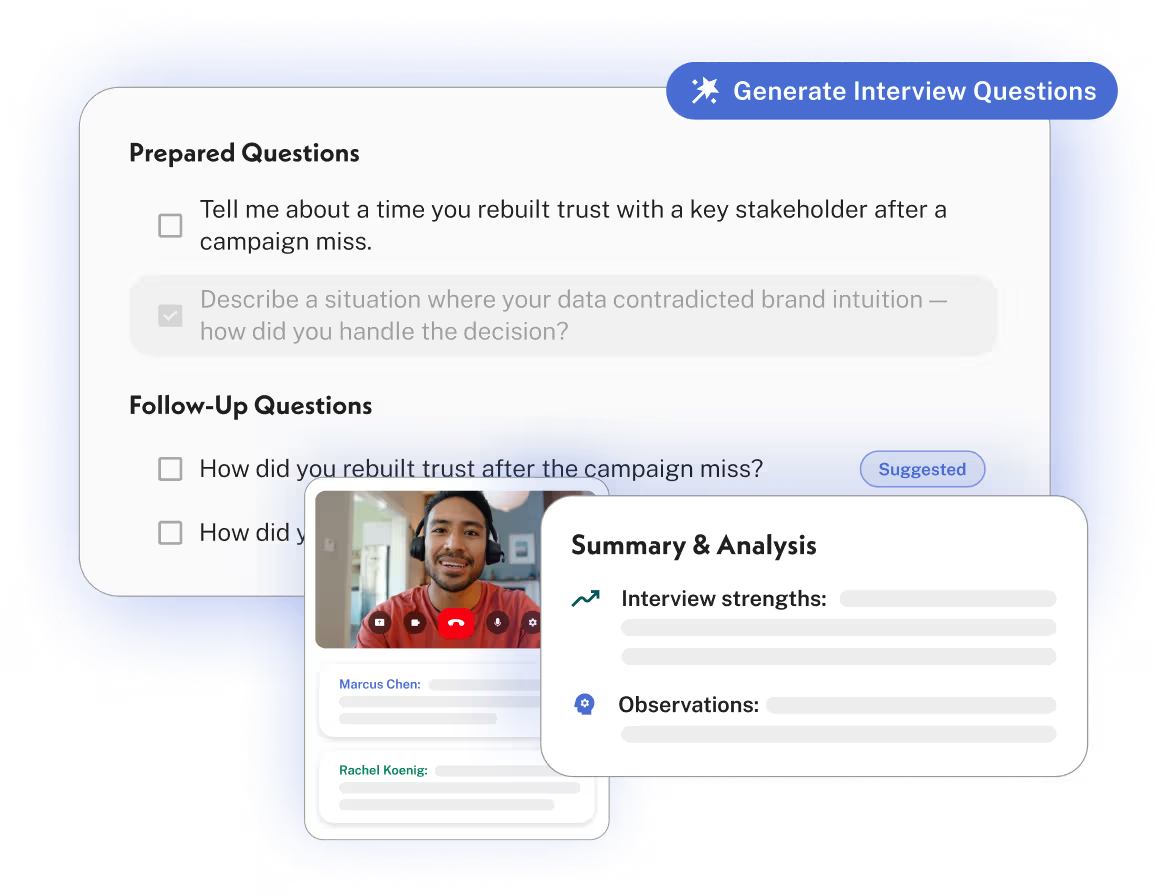
Sophie Roberge: And also imagine, you know, we have over 100,000 candidates now in Ashby. We've hired about 1,000 so far, so 99,000 were rejected. And so imagine opening this to everybody. Everybody can have an AI screen now. Um, even if your resume is not an exact match, we'll invite you to talk to you or you get, get to talk to an AI agent. I think if I was a candidate now and I was faced with I would absolutely take it knowing that it's putting me in a minority of people who are willing to take that screen to begin with. But it was fairly low. The platform was new. Uh, it was not really integrated with Ashby, which made it a little difficult, right? So we could tell in Ashby they took it, but we had to go to another, uh, platform to see and to see the results. And ultimately, you know, we have to kind of watch the video and listen to their voice tone because people work in sales. Our garage door technicians are customer-facing. They work in sales. So we wanted to hear, um... And so ultimately it was a great first trial, but because it had no time saving and the lack of integration, we decided to, um, to sunset that one. And then we tried another one, uh, that was a little bit better and a better integration. Um, and a third one, which is the smartest one of the three, but again, the integration is not there and there's a lack of customization. So the customization for me is really, really important. It needs to be branded. It needs to look like us. I don't want candidates to feel like there's so many scams now and people feel like they're always clicking links to get on this and to get on that, and they don't know what they're clicking on. So when they apply for a role, it needs to be completely integrated in the experience. It needs to look like Day One. It can't look like a third-party platform. Um, we need to be super transparent as well. So this is something we're gonna be better when we're launching. Ashby's finally launching their own integrated AI screen agent. Um, it was an acquisition from Talent Llama, and so I trust that the tool is going to be really great. So it'll be perfectly integrated, but I'm a huge fan of transparency, so it needs to be right in the job description. "Hey, this is what the interview process looks like," or, "This is what you can expect." So if people know there's an AI screen, they can prepare for that. We're also gonna give them the option to opt out from the beginning. "I don't want an AI screen at all. If somebody's gonna screen me, it needs to be a human, not an AI agent." So we're gonna give people the option as well. Um, and I think that's a huge one. So we'll be integrating, uh, embedded video as well to let people know why we're doing this. And in my opinion, it's a huge benefit to candidates. My team's not growing and we're opening new locations, we're acquiring new locations, we're opening new ones, and so the job is not gonna get any smaller. We just need to get a lot smarter with the tools. So I think by being transparent, by being seamless, saying it upfront Making it easy for candidates as well. It's not gonna be actually, uh, a video interview, it's only audio. I think the video was also a big deterrent for people.
Colleen Gallagher: Mm.
Sophie Roberge: They feel they have to be perfect, and the room has to be clean, and the cat can't be around, and their hair needs to be okay.
Colleen Gallagher: Yeah
Sophie Roberge: and so I think the video was a deterrent, so this version will not be, um, a video one. And I also think with time, people are getting used to it.
Colleen Gallagher: Yeah,
Sophie Roberge: people
Colleen Gallagher: I think so
Sophie Roberge: one, and there's definitely two camps, right? You see them. "I had a video or AI interview and it was horrible." Or somebody will say, "I had an AI
Colleen Gallagher: Yeah.
Sophie Roberge: And it was actually pretty great." Like,
Colleen Gallagher: Yeah
Sophie Roberge: it was seamless, it was smart. Um, I think the product makes a huge difference.
Colleen Gallagher: Yeah
Sophie Roberge: have a product that constantly cuts off people or is not smart enough to respond so the customer goes, "Oh, do you mean..." The, the candidate goes, "Oh, do you mean this? Or are you more asking me about this?" Great. Thank you for that.
Colleen Gallagher: Mm-hmm.
Sophie Roberge: Know, if you have an AI tool that's a little bit dumb, um, obviously candidates are gonna go, "AI's dumb, and I don't wanna do this." So I'm a big advocate for smart tools. Not, not, not just a, a tool or any tool, but like a great product. And I'm, I'm a, I'm, I've been a candidate too many times, and I'm sure
Colleen Gallagher: Yeah.
Sophie Roberge: Again.
Colleen Gallagher: Yeah
Sophie Roberge: And, uh, I want that experience to feel smooth, and I wanna know what's
Colleen Gallagher: Yeah
Sophie Roberge: and I want it to serve me as a candidate, not feel like I'm just being processed.
Colleen Gallagher: I, I guess, you know, obviously it sounds like your team moves quickly. Um, there's, you know, a lot-- When you're dealing with volumes like that, you have to have really good processes in place, and you have to have people who are motivated. And h-how do you hire for the right folks to be recruiters in an environment like that?
Sophie Roberge: Yeah. It's not for everybody, that's for sure. I mean, there's a part of the job, it's incredibly repetitive. So my recruiters that are working in the field, more specifically the ones that hire garage door technicians, uh, you know, they'll do 40 to 50 screens a week themselves. And so, and it can be quite repetitive. And, but they are completely embedded with operations. I have a strong background as an operator. I grew up in retail, and I started my career, the first 15 year was at Ikea as an operator. And as a project manager, I was hiring a lot of people because I had to open stores. This is kind of how I got into recruiting. But at, that operator mindset for me has always served me well, and that project management mindset as well, right? And so if I know that I need to be at 74 headcount for the Phoenix location by the end of the year, deconstructing this kind of project management mindset and working with operations. And so my recruiters are operators. They definitely, they understand their hiring managers. They, you know, we're incredibly active on Teams. have weekly meetings with them. We go on their location. We know exactly what they're looking for. And, um, we're very, very embedded. And so they work for the business. They, you know, they know our north, my north star is always the candidate experience, and branding A-1 is the best place to work for, for home services, um, and in sales. But, um, their job really is to serve the business. You know, the business can't reach their goals if they're not staffed properly, and they're not staffed at the right quality as well. So,
Colleen Gallagher: Mm-hmm.
Sophie Roberge: Um, they're very humble people. They don't take anything personally. And I really look for people that take feedback and go, "Well, that wasn't so good. Let's, let's figure this out," right?
Colleen Gallagher: Yeah
Sophie Roberge: so I create a really safe environment for people to be in. It's
Colleen Gallagher: Yeah.
Sophie Roberge: I make mistakes too.
Colleen Gallagher: Yeah
Sophie Roberge: And only people who don't do anything don't make mistakes. I really believe that. And
Colleen Gallagher: Yeah
Sophie Roberge: are gonna process this many people and this m- and gonna make this many hires, some mistakes are gonna be made. It's just critical that we don't do, same mistake twice, right? So it's okay to make mistakes if you, you know... I had a recruiter recently who archived like 800 people and, um, the email wasn't attached to it. I was like, "Oh my gosh, 800 people got rejected, but they'll never know 'cause they didn't get an email." And I just couldn't sleep at night, so I'm like, "We have to figure out a way, um, to find those candidates
Colleen Gallagher: Yeah. Yeah
Sophie Roberge: and fix that." But it's not, uh, you know, we, we can all make mistakes, and I think that's really important. But so that north star of the candidate first and then the business as well, um, is really what keeps the team going.
Colleen Gallagher: you talk about being embedded in the business, and so how do you, um, develop those, those relationships with the hiring manager and, and just make sure that they see, see you all as a partner?
Sophie Roberge: think that, um, understanding the operations, understanding results, and understanding goals. Like I love a scoreboard, like a scorecard, or I love metrics. I've never met a metric I didn't fall in love with. I've, I, I wanna know what they are. Is it gross close on the job average, conversion rate, financing percentages? Like I know the metrics that a company operates, and I know the year goals, and I know are we on budget or ahead of budget and where we're behind, the utilization, the scheduling percentage. So I know the metrics, and I speak those metrics. And so I think that's really important for the business because when HR or TA is detached from the business, there's no respect there. We're
Colleen Gallagher: Yeah
Sophie Roberge: you know, paper pushers, and I'm, I'm not interested. I always wanna make the business move forward. And so I go to all of the, you know, technician meetings.
Colleen Gallagher: Mm-hmm.
Sophie Roberge: There's a technician meeting every Thursday morning, and I will attend the one from Phoenix all the time, or I'll log into the one from Houston or other locations. Uh, we have a training academy in Phoenix where we train 60 technicians a month. We fly them all in from all over the country, and they stay with us. So I go to kind of the opening, the graduation ceremony as well. Um, I also always keep one location at least. Like right now I'm recruiting for Philly. It's a new location for us, and I really wanted to kinda get the tone, the culture, the quality of candidates, where people live, how difficult it is to hire before I move this location to the recruiter for the East Coast. I wanted to own it to get a good feel for it and also adjust strategies if we needed to. so that's how I do it. You know, I speak the business. I'm interested in the metrics. I go to the meetings. I ask questions. And when we have employees that leave or don't last, I, um, I, I, I take it seriously, and I wanna find out why and what we could've done better as a company. So I, I see myself really as a partner and as a maximizer and an optimizer, and I bring speed to the business, and I bring profit to the business.
Colleen Gallagher: Yeah
Sophie Roberge: Um, I-- my role in HR I find is very, you know, critical for that, and, and, and I w- I invite others
Colleen Gallagher: Yeah.
Sophie Roberge: Well.
Colleen Gallagher: Yeah.
Sophie Roberge: Operations.
Colleen Gallagher: Yeah. How, how do you, um... What are some metrics that you use for your team specifically?
Sophie Roberge: Yeah. I mean, we have some very specific goals for hiring per location, um, because we work our budget backwards. So if we have a certain location that, you know, makes $12 million a month, they need so many technicians to take so many leads at a certain conversion rate. So again, kind of project management style. So, um, headcount per location for us, like my metric is 100% staffing for priority locations. So that means markets that are growing, markets that just opened, so that's 100% staffing for that. The rest of the country is at 97% staffing is the goal, and that's because there's always departures, and can't always backfill ahead of a departure. Um, but that's a really important one for me. We also look at, um, quality of hire. That's a very elusive key metric, that
Colleen Gallagher: Yeah
Sophie Roberge: and recruiters fall in two camps: "I hate quality of hire 'cause it can't be measured," or, "I love quality of hire." So we spend quite a bit of time at A1 to develop quality of hire. So what-- The, the first way that we do it is by having a hiring manager survey 60 days out and 120 days out. So gets hired, there's an automated survey that basically says: Would you hire this employee again? Rate them one to five. Do you have any feedback? And so we're able to see per location, um, you know, the kind of the satisfaction level from our hiring managers. We also look at turnover, so early turnover generally is an indication. I won't own it a year later, but within 90 days or 60 days, I think it's probably fair, um, that we may have missed a mark on somebody. We were not clear enough on the expectations, or we misidentified. Even though we're only screening, we're not really doing the full interview, the hiring managers have a share in that as well. Um, but I do own, uh, early turnover, so up to 90 days is something that we measure for sure.
Colleen Gallagher: Yeah
Sophie Roberge: um, we're just starting to build a scorecard, so, uh, we have a certain average amount that we want every technician to bring in at 60 days. So
Colleen Gallagher: Hmm
Sophie Roberge: imagine a technician goes to your house, you need a new garage door. I'm gonna use a fictitious number so I'm not oversharing, but let's say it costs $1,000 for the repair on that day. We have a specific goal, let's say, of $1,000 60 days out graduating from the academy, and so that is a quality indicator for us
Colleen Gallagher: Yeah.
Sophie Roberge: Our garage door technicians, they go to your house. You call because you have a problem. They need to solve the problem.
Colleen Gallagher: Yeah.
Sophie Roberge: Solving the problem, they're not selling anything. So we have a goal for that. So we measure, uh, kind of a, you know, the quantifiably with that, you know, dollar amount. We also measure from the manager's point of view, um, and we measure with the turnover report as well. So that quality of hire is really critical. And then we have all the rest of our, of our, our key performance indicators. Time to hi- uh, time to offer are usually 15 days, so 5 days to get to recruiter screen, 5 days to get to hiring manager interview, and that depends of the availability of the candidate, of course, and the hiring manager. And lastly, we put every one of our candidates through a full day of ride-along, so they get to ride with another technician
Colleen Gallagher: How interesting
Sophie Roberge: so we schedule them that. So it's 15 days for those three things to happen before they go to offer. Still a fairly, um, you know, fast process.
Colleen Gallagher: Tell me more about the ride along, ride along. Um, what's the, what's the goal of that portion?
Sophie Roberge: Yeah. So a huge piece of that is for the candidate to see what life is like as a garage door technician. A lot of people that come from home services, whether they've done plumbing or roofing or, um, pest control, are familiar with that, right? They have a van, they call the customer, "I'm on my way to your house. I'll see you in 45 minutes." They get there, they do the inspection, they tell you what happened. Um, but this is a very heavy sales role. Um, you know, when we go to... A- and, and this is something a lot of people don't know about the trades. You know, people in trades are commissioned,
Colleen Gallagher: Mm-hmm.
Sophie Roberge: And that's because if they, if you say, "Oh no, this is too expensive," and you leave, um, you know, the company makes no money. So we don't pay people hourly in the trades. Most trades pay people, on a commission basis. And so there's a huge part of it that is sales, and we want our candidates to see that aspect. You need to like customers. You're
Colleen Gallagher: Yeah.
Sophie Roberge: Home, right? Like, so as a customer, you want to be able to trust your garage door technician. That's really important. They need to be friendly. They need to look professional. They need to care. They need to have good work ethics. They need to have integrity, right? They need to give you an estimate that makes sense, so they need to listen to what your needs are. They need to give you the correct estimate and do a proper inspection. Um, but the reason we do the, the ride-along is because we want the candidates to see the process, right? So drive quite a bit, you know? You might be in this side of town in the morning and this side of town at the end of the day. So there's a lot of time driving, and then there's that whole relationship part of it that people need to understand. 'Cause a lot of guys are like, "Oh, I'd be really good at being a garage door technician." They'd probably be great at being an installer, right? Like, if they want to do the mechanical work, that's one job. But being a garage door technician, it's sales and service.
Colleen Gallagher: Yeah
Sophie Roberge: and then there's a repair part of it. You're in a hot garage, you're in a cold garage, you're up in a ladder, you're working with your hands up in the air 75% of the time. So it's not for everyone, and this is really a great way for candidates to self-select out. And also, the garage door technician that is taking them onto their van will also assess them. So they'll say, "This guy was great. He asked all kinds of questions. He offered help. He was really observant. you know, he was professional."
Colleen Gallagher: Mm-hmm.
Sophie Roberge: And then other times it'll be like, "This guy was on his phone the whole day, and, you know, he
Colleen Gallagher: Yeah.
Sophie Roberge: Car, and he," you know, like
Colleen Gallagher: Yeah.
Sophie Roberge: So we're like, "Okay."
Colleen Gallagher: Real things, yeah
Sophie Roberge: us who they are. So we try to keep it as, uh, you know, as condensed as possible as a process, but that day of ride-along is definitely something that, um, has really helped us in refining that, that quality. And the candidate comes back after going, "That was amazing. I love that. It is totally something I can do." Or sometimes people will come back and say, "You know what? I don't think this is for me. I
Colleen Gallagher: Yeah.
Sophie Roberge: How much sales there were," or underestimated how much in the elements that was gonna be,
Colleen Gallagher: Yeah
Sophie Roberge: when they have ride-along in Oklahoma in January, like,
Colleen Gallagher: Yeah.
Sophie Roberge: They get to see
Colleen Gallagher: Yeah.
Sophie Roberge: Are pretty cold.
Colleen Gallagher: Yeah.
Sophie Roberge: So it's not for everybody, and I think it gives everybody a chance to see, uh, if they could, you know, picture what life would be like if they worked with us.
Colleen Gallagher: Yeah. you mentioned earlier, um, you know, you have a program that you fly people in and they can go through. Um, and I know one of the challenges is a lot of recruiters live on LinkedIn, and this is probably not necessarily something you can go source for these types of roles on LinkedIn. So, um, you know, h- how do you find this? What, what percentage of folks are coming through from, you know, the o- your own training programs or how are you building out your talent pipeline?
Sophie Roberge: Yeah. Oh my gosh. This is by far the most challenging industry I've ever worked in. Um, and I'm telling my friends that are still in tech, I'm like, "I could hire a software engineer way faster than a garage door technician," because you can find those people. They're
Colleen Gallagher: Yeah.
Sophie Roberge: Identifiable, right, on LinkedIn. Um, most-- if we're hiring from garage door companies, we don't find them on LinkedIn. It's very, very rare. Some operators will be on there, but, you know, we have used, um, our LinkedIn Recruiter license every which way to find garage door people. It yields very few results, and generally, you know, they may have been retired or it was a mom and pop kind of owner-operator. We're not seeing a lot of those guys. But, um, so we, we get most of our candidates from Indeed. So about 70% of our candidates come from Indeed. And so we, we heavily sponsor our roles, and our roles are designed to pop up when people are gonna look for a job in sales or a job in the trade. So that combination that we look for is people with a hospitality or a sales background. Um, and that combination of additional mechanical skills is incredible, right? So somebody that may have been an, you know, a mechanic, or maybe they don't have it on their resume, but they have great sales experience on their resume, and when we get to know them, you realize that their dad was a contractor, and they grew up building houses with them, and they put an addition to their house. So that mechanical aptitude, they don't need to be bulletproof, but, um, somebody that knows their way around tools is always a huge shortcut for when they come to the academy. So we do-- So our jobs are on, um, Indeed. We get about 70% from Indeed. We get about 5% from LinkedIn, mostly for our corporate roles, right? So finance, accounting, HR, uh, marketing roles would be mostly found on LinkedIn through our Recruiter license. And, um, and then we have a huge referral program. So we do very, very, very well with our referral program, so that's been a really great pipeline for us. Um, generous with our referral program. We offer $5,000 for a hire. So it's $500 when they get hired, 2,500 when they graduate from the training academy, and the balance at six months. And so that referral program, um, is a great, like, benefit for employees, and generally, they wanna make that money, so they find great people for us. Um, so that's, that's really how the pipeline is built through, uh, referrals mostly, uh, Indeed as well.
Colleen Gallagher: you, you spent a number of years at Lucid Motors before, um, before your current role and had to do a bunch of high volume or, or hire for rapid growth there. I think one of the, the things on your profile talks about hiring 1,200 people in 18 months to get an EV factory ready.
Sophie Roberge: Yeah.
Colleen Gallagher: H- how did you do that? Um, and, and what were the types of roles you were hiring for there?
Sophie Roberge: Yeah, that was a ton of fun. Yeah, Lucid, I was there for four years, started out in manufacturing and over time kind of migrated. So started manufacturing, took over logistics and supply chain, and then took over sales and service, and then go-to-market and GNA, and then got Europe started and KSA. So I feel like I had 11 jobs when I worked at Lucid in those four years. But
Colleen Gallagher: Sounds like sofie_1_07-31-2026_101308: um, to begin with, when I started, we were in Casa Grande, which is about 40 minutes south of Phoenix, and that's kind of in the middle of nowhere. There's about like 12,000 people that live there and, um, only about 3,000 are of working age, and we needed to hire like thousands of people for the plant and, and we needed to do this fast. And so, um, it was-- So we did a lot of hiring events when we got started. So I
Colleen Gallagher: Yeah.
Sophie Roberge: We had AI in those days, oh my goodness, because, uh, the requirement was to be 18 years old, to have the ability to be on your feet, you know, to speak and understand English for safety reasons. In a factory, there's a lot of fac- there's a lot of things you need to understand how they work and be able to, um, you know, work safely. And so the requirements were fairly low, but the number of people that we needed to hire were very, very high. And so if we would've had AI, then we would've crushed this with like half the team, 'cause I had 15 recruiters at the time. We screened every single person one by one. Can you imagine? This is like a... We would never do it like that anymore.
Colleen Gallagher: Yeah.
Sophie Roberge: But we
Colleen Gallagher: True
Sophie Roberge: massive hiring events. So we, we started doing branding early. So we went to the chamber of commerce and the radio station, and it was a lot of noise about Lucid too, right? Because electric vehicle company in the US, there's not that many. There was Tesla to begin with, and then there's us. And so, um, there was quite a bit of noise for that. But we started having, uh, hiring events. Our first one was in Casa Grande in a strip mall, and we had like 1,000 people that showed up on that day, and we hired the first 400. And then
Colleen Gallagher: Well
Sophie Roberge: you know, referrals for those people. They started inviting their friends and their family. And so, you know, w- in a smaller town, we are such a big fish, you will attract a lot of, um, attention. And then obviously the first hires, we were so intentional. You know, we wanted people that were gonna be great coaches, for example, right? They were gonna be, um, all in, right? So like from a culture point of view. And then of course, as time went by, we're like, "Okay, we need a second shift. We need a third shift. Maybe we need to loosen up a little bit." We can't reject 80% of people, because we're gonna run out of population, right? Like you can't get to that
Colleen Gallagher: Yeah. Yeah
Sophie Roberge: No. And so, you know, if you're gonna pay people 18 bucks an hour and they need to drive an hour in, an hour out, um, you know, we're gonna have to loosen things up a little bit. But we got there through just like really, really hard work. I don't think we're as smart as we are now with technology. I think now would be a whole different ballgame. Um, but so our most successful hiring initiatives were massive hiring events where we would invite people, they would have to apply for the job and confirm that they were coming, and then we had like 60 hiring managers, and it was like speed dating. So we were very systematic, and they had their laptop, and they were like hire, hire. And then my team was like sending offers, and it was kind of like a little, uh, assembly line. It was fun though. It's, it's, it's great team building
Colleen Gallagher: Yeah.
Sophie Roberge: Through
Colleen Gallagher: I bet. H- how do you balance or like what, what did you look at then in terms of like retention and, um, how did you refine it over time as, as the, I guess as the factory got working, right? Because it, it was, it was new
Sophie Roberge: It was new, and you know, it was during COVID. I started in July of 2020, and supply chain was a huge problem, so there was a lot of
Colleen Gallagher: Yeah
Sophie Roberge: stops, which was very, very difficult on our workforce. Um, you know, like you start production, but then you're missing parts. We had to send people home halfway through the day 'cause just we didn't have the parts for it. And so sometimes you could, you know, reorient them. So there's a lot of cross-training happening, one, right? So you can cross-train people in different areas. And then the scheduling became, you know, operations had to be other game. You know, if the parts didn't come in at 6:00 in the morning, then you schedule people for 10:00 instead of 6:00. And, you know, we try to have everybody working as many hours as possible 'cause people need to earn a living as
Colleen Gallagher: Yeah.
Sophie Roberge: Wa- it was a very, very difficult balancing act, for sure. you know, jobs were hard to come by too during COVID, so w- we had a, really, really good, um, surprisingly, because
Colleen Gallagher: Yeah
Sophie Roberge: not that many jobs, and two, you know, in Arizona, if you can-- you know, folks who are making a lower wage, right, 18, $20 an hour in a factory setting, that factory was just like a museum, uh, of modern art. It was so beautiful. It was all robotics, and it was very cool because it had to be air-conditioned to keep a certain degree for the robots. Um, and so it's a treat for a lot of people that have done a lot of manual labor and have done kind of lower wage labor. And so people tended to stick around
Colleen Gallagher: Yeah
Sophie Roberge: because it was just a beautiful environment that was safe and clean and cool. And so, um, people tended to stick around.
Colleen Gallagher: I guess shifting gears a little and learning more about, about you and how you got into all of these, um, these, these situations and, and got interested in doing this. Like, what, what got you, or what was your path into, into recruiting?
Sophie Roberge: I really got the bug when I was doing project management and opening new stores for Ikea. And so I was born and raised in Quebec City and moved to the US. Um, it was supposed to be for a six-month project in Costa Mesa in California near 2000, and it's 2026 and I'm still here. But so yeah, we were opening a new store there, and when you open a new store, you need to hire about 500 people, and it is the task of the project manager to hire all those people. We didn't even have HR at the time. There was like an HR person, but they were more like a payroll person really. And so at the time it was our job to organize like hiring events and to start advertising jobs. And in 2000, we were still advertising jobs in newspapers and like sign, like signs on the freeway, and we were hoping people would show up. Um, and so I remember kind of organizing those hiring events with kind of like, uh, almost, you know, like when you go to a timeshare and they pitch you at first and then you have to
Colleen Gallagher: Yeah. Yeah
Sophie Roberge: So we would talk about Ikea and the culture. I mean, it is a very cool company, so it attracted a lot of people. Amazing culture. People love Ikea. People drove from very far away to apply for jobs there. So we had incredible candidate base. People are already like fanatics before, and they wanted just to kind of like Trader Joe's, like Apple. Also worked for Apple, another cult following company. So we attracted a ton of people, but kind of with that operations mindset, you know, like having a video presentation and talking about all the possibilities in the future, and then kind of splitting the groups by different functions and then empowering the managers to make decisions. We didn't even have interview guides or anything like that. It'd be like, "You're hired." Right? We'd like write them an offer. Um, it was a ton of fun. So I-- But I really love that part. I love finding people that are like bright and they're so interested in what you're doing, right? So
Colleen Gallagher: Yeah
Sophie Roberge: really driven, that have the same kind of values. Um, that was a lot of fun for me. And then I did a lot of, uh, leadership hiring and leadership development, especially when I went at Apple. So at Apple I was working the people function, a lot of leadership development. That was really, really cool.
Colleen Gallagher: Mm-hmm.
Sophie Roberge: And, um, a ton of recruiting too. So Apple was-- I was working in the field, so retail in the people function, and Apple has a very interesting way of hiring people. But we tended to attract the same profile of people over and over again, right? So we tended to attract young guys, right? Like early 20s, super high tech, love the brand, right? Like kind of big fans of the, of the brand. And when I was working in a store, I could see that we had mostly female customers and mostly over the age of 50. And so we had a massive disconnect between our customer base and our employee base. And a lot of customers would come to me and go like, "Hey, can you help me with something?" And I'd be like, me get you somebody that can help you." 'Cause I was, like, managing the floor, all the operations. And they'd be like, "No, I wanna talk to you." And
Colleen Gallagher: Yeah
Sophie Roberge: really realized that our workforce was not mirroring, um, our, our customer base. And so we started a whole initiative of diversity and kind of recruiting, like boots on the ground, like going to Chico's and talking to a lady who talked Chico's who
Colleen Gallagher: Yeah.
Sophie Roberge: Friendly. And I recruited a lady from Chico's to come work at Apple, and she was a rock star. And another one who, you know, came in the store and she was awesome. She's kind of semi-retired and, um, like, "What are you doing?" And she's like, "I would love to work here." I was like, "Awesome." So we started recruiting people that, uh, were a lot more diverse, you know, software engineers that were retired and, you know, moms that need to work part-time. And so we kind of really kind of brought diversity. And those kind of strategic challenges is really what keeps me excited about recruiting. So I
Colleen Gallagher: Yeah
Sophie Roberge: recruiting because of operations and found that people, I mean, people make operations, like people make operations,
Colleen Gallagher: Right
Sophie Roberge: But kind of I've-- I, I love those, those kind of strategic challenges where just observing, like standing in that Scottsdale store going, "We're
Colleen Gallagher: Yeah.
Sophie Roberge: I
Colleen Gallagher: Yeah.
Sophie Roberge: People on the floor."
Colleen Gallagher: Yeah.
Sophie Roberge: That was fun.
Colleen Gallagher: Yeah, and it just, and it ties back, too, to, you know, what you're doing now around, um, you know, looking at, you know, there's not a, a bunch of folks on LinkedIn saying that they're, you know, garage door technicians. You're looking across and seeing, like, what are the transferable skills? Where can we train people? And making sure that we're, you know, bringing people to our customer base that look like them, that talk like them, that are gonna be a- appreciated and sort of,
Sophie Roberge: Yeah
Colleen Gallagher: be able to build that rep- the rapport with them. So that's, uh-
Sophie Roberge: yeah, I think that trades are having a moment though. I think that trades are having a moment right now. A lot of people realize that you can make a great living in trades. Um, and, um, you know, you don't need to have a very long, uh, training, right? Um, garage doors is about two months, but, you know, electrical, plumbing, you don't need like a four-year degree. And so I think trades are actually attracting a lot more people than we used to, and people see this in much more kind of, um, a
Colleen Gallagher: Yeah. Yeah.
Sophie Roberge: Yeah.
Colleen Gallagher: amazing. Well, thank you so much for joining. Um, this was so great to hear, you know, just the themes around operations and sort of having that creative mindset around, like, what do you ne- what do you need to do to h- to get to the goal? And, like, even when you outlined, you know, w- uh, knowing what the business goals are and making sure that you have a plan to get to that, I think, um, is often what, you know, has to be done in order to meet goals, whether you're hiring 10 people or you're hiring, you know, 1,000 people a year. And so, um, really sage advice, and really appreciate you joining us today
Sophie Roberge: It was a pleasure, Colin. Thank you so much
Colleen Gallagher: What's the ba- best way for people to find you if they wanna get connected?
Sophie Roberge: Uh, people can find me on LinkedIn. Uh, first name, last name, Sophie Roberge. I'm easy to find. I think I'm the only one on LinkedIn maybe with that name.
Colleen Gallagher: Yeah. That's always great.
Sophie Roberge: That's always great. Yeah
Colleen Gallagher: Well, thank you again, and thanks to all our listeners. This has been another episode of "The Talent Bar." Thank you for joining. Talk to you soon.