.png)
By Kaushik Nagaraj, Textio Chief of Staff
AI now drafts job descriptions, screens resumes, transcribes interviews, and writes candidate summaries — and regulators are paying attention. For talent acquisition leaders, the question is no longer whether AI belongs in the hiring stack, but whether your use of it can withstand scrutiny. The encouraging news is that the rules are more navigable than they look, because underneath the patchwork of regulations, they ask for the same handful of things.
The landscape does look complicated at first. In the United States, there is no single federal AI hiring law. Instead, there is the patchwork.
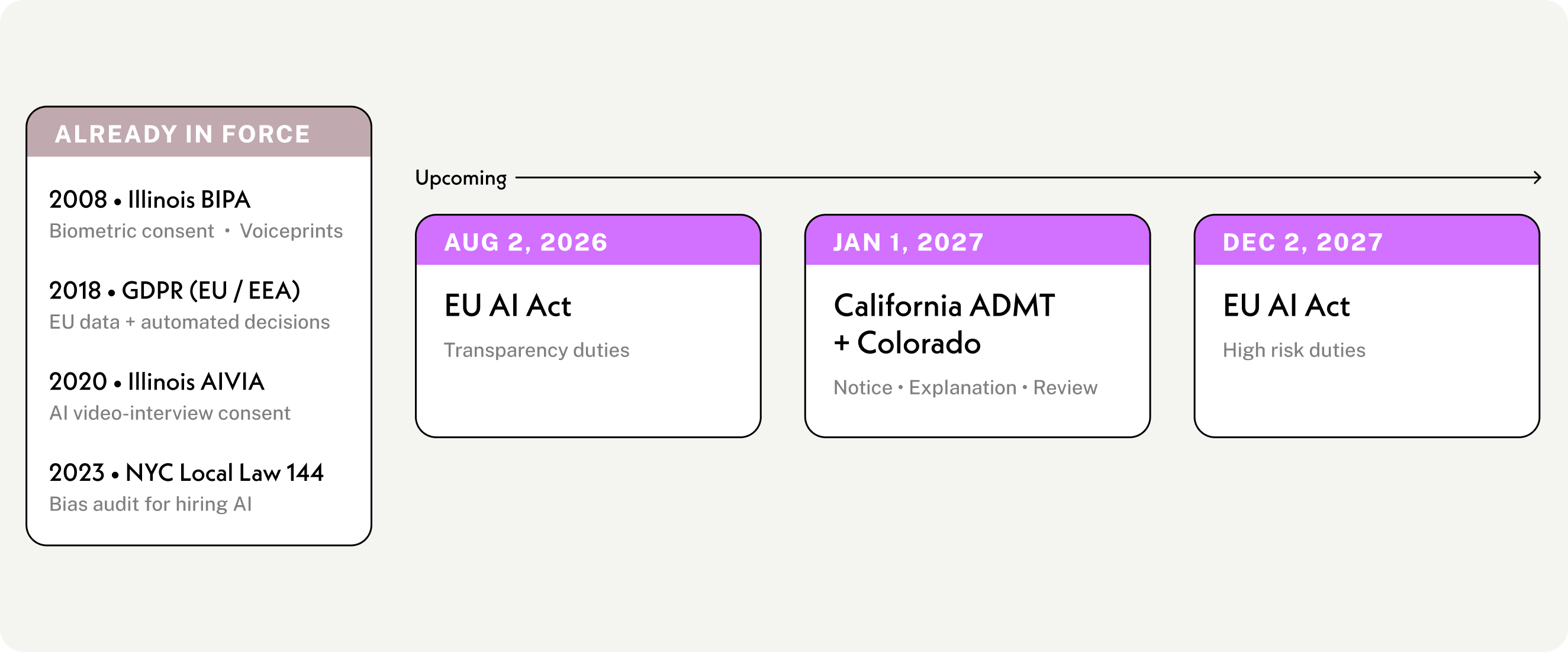
New York City’s Local Law 144 requires bias audits for automated employment decision tools. Illinois regulates AI analysis of video interviews and, through its Biometric Information Privacy Act, imposes strict and heavily litigated rules on anything resembling a voiceprint (think of this as the audio equivalent of a faceprint/facescan). California’s new automated decision-making rules and Colorado’s revised AI Act both take effect on January 1, 2027, layering in notice, explanation (showing the candidate how a decision was made), and human-review obligations. Across the Atlantic, the EU AI Act classifies hiring AI as “high-risk,” while the GDPR (UK, EU) governs how candidate data moves and how decisions must be explained.
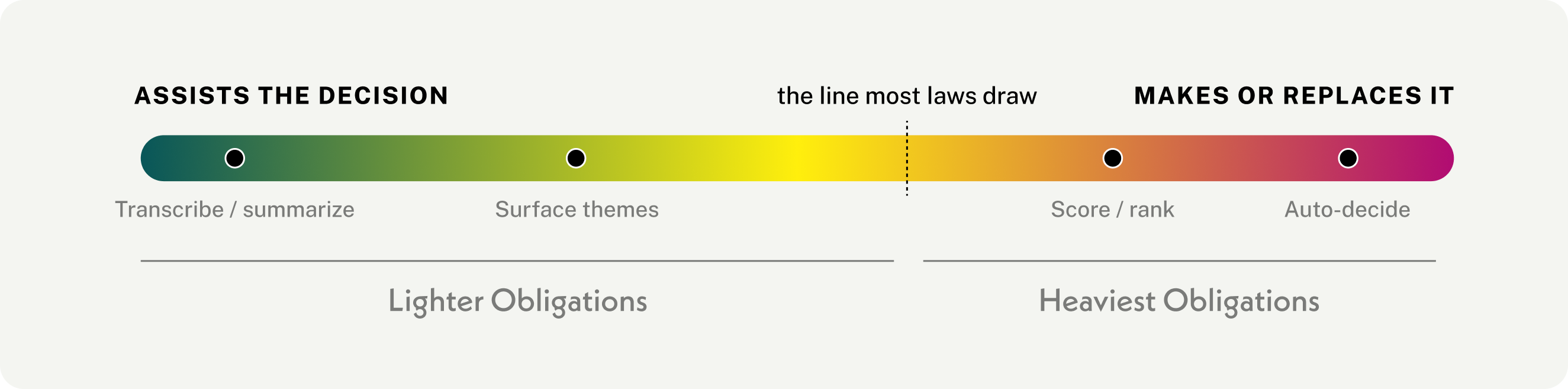
Beneath the alphabet soup sits a single core idea: The law cares most about whether a tool makes or replaces a hiring decision, rather than merely assisting one. A system that scores or ranks candidates and drives the outcome attracts the heaviest obligations. A system that summarizes and informs, leaving a human genuinely in charge, generally does not. That line between decision-support and decision-making is the most important concept for any TA leader to internalize.
So what should you, a TA leader, spend your time thinking about? Four things.
Start by auditing your hiring practices and where you utilize AI. Then be sure to get with your legal counsel to discuss how your tools work to determine if they comply with the newest regulations.
1. Get notice and consent right.
Tell candidates when AI is involved and, in the strictest states, obtain explicit written consent before any recording or analysis. Since some states set a higher bar than others, it can be a good idea to design your process to meet the strictest one, and you'll automatically clear the easier barriers everywhere else.
2. Keep a real person in charge, and be able to show it.
The law expects a human, your recruiter or hiring manager, to genuinely review what the AI produces before it affects a candidate. That means they actually read the AI's output, weigh it alongside everything else they know about the candidate, and have the power to disagree with it. Someone who just signs off on whatever the AI says won't count.
3. Be ready to explain a decision.
Several laws give candidates the right to ask how a decision about them was made, so you should be able to explain, in plain terms, what information was used and how the AI factored in. One important limit: you can explain a candidate's own result to them, not how they ranked against everyone else. In fact, sharing that comparison can violate the other candidates' privacy, so there's no "leaderboard" you're expected, or allowed, to hand over.
4. Check for bias and mind your data.
Two habits do a lot of the heavy lifting: regularly checking whether your tools advance candidates of different races, genders, and ages at similar rates, and keeping clear rules for how long you store candidate data and when it gets deleted. Do these two well and you cover a surprising number of the laws above at once.
Three questions for you to think through and then work with your legal team
None of this requires slowing your AI adoption. It requires intentionality. The organizations that treat compliance as a design principle, rather than an afterthought, will keep the efficiency these tools offer while earning the trust of candidates and regulators alike.
For TA-focused summaries of each regulation, plus info on the locations affected, hiring stages affected, and what TA leaders can do and ask: check out Lavalier's AI Regulations in Hiring tracker.
This article is for general informational purposes only. It does not constitute legal advice and should not be construed or relied upon as such. Consult qualified legal counsel regarding your specific circumstances.
† This post reflects the regulatory landscape as of July 2026. These laws are evolving quickly. Effective dates, thresholds, and obligations continue to change, and several remain subject to ongoing rulemaking. For the current status of any requirement, refer to the text of the regulation itself rather than relying on this summary.